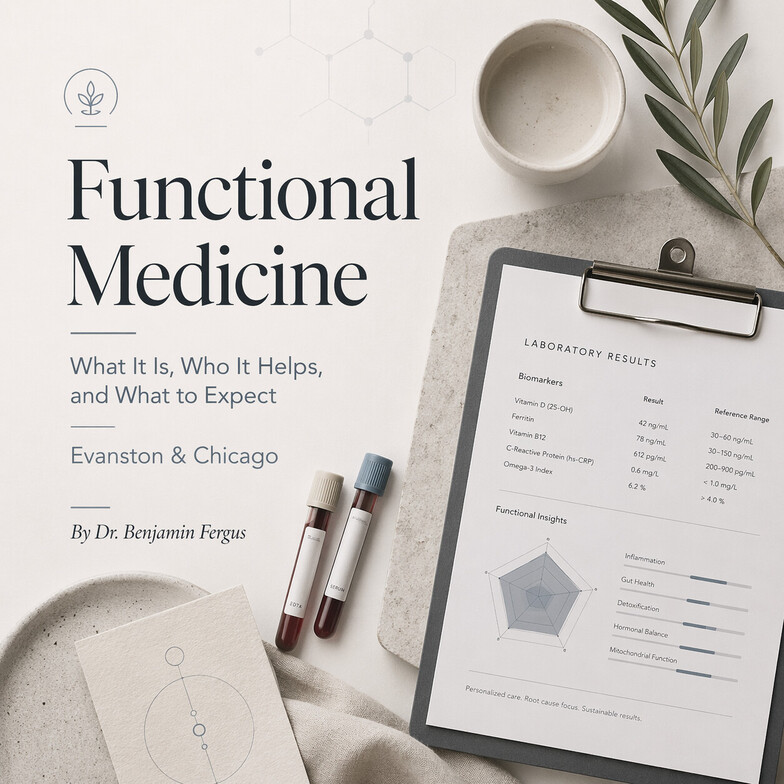
I’m writing this because I’ve always been interested in building health proactively—getting better month to month and year to year, not living through cycles of progress and setbacks. Functional medicine is a structured way to do that: it focuses on foundations and identifies the 1–2 highest-impact drivers behind your symptoms so you can improve health and longevity as naturally and minimally invasively as possible. Here's more about what makes functional medicine unique.
What functional medicine actually is (and why it’s different from traditional care)
Functional medicine is a systems-based approach to chronic and complex health problems—built to answer a very specific question: “What’s driving this pattern?” Rather than treating symptoms in isolation, functional medicine looks across interconnected systems (metabolic health, inflammation, gut-immune signaling, hormone and stress physiology, sleep/recovery, nutrient status, and lifestyle inputs) to identify the highest-impact levers that can shift the whole picture. Dr. Mark Hyman often describes this as moving from a disease-centered lens to a root-cause, patient-centered lens—using a structured framework to connect symptoms, history, and objective data into a plan you can execute.
The biggest difference is the time and care to ask, "Why?" and formulate a clean and effective plan to address the cause rather than the symptoms it creates. Traditional primary care and specialty care are essential, but they are frequently designed for speed, urgent decision-making, and narrow problem lists. That model can be less suited to cases where symptoms are real but multi-factorial: fatigue + brain fog + gut issues + pain + sleep disruption + weight resistance. Functional medicine tries to solve for that complexity by doing deeper pattern recognition and biomarker interpretation—work that often requires substantial clinician time between visits (reviewing results, mapping relationships, and refining the plan). A helpful academic framing is that functional medicine can function as an “operating system” for clinically applying systems biology—connecting mechanisms to real-world care plans.
Leaders in the functional/integrative space emphasize different angles of the same core idea:
- Dr. Mark Hyman highlights systems thinking, nutrition/lifestyle foundations, and using frameworks to connect the dots.
- Dr. Alex Vasquez has published and taught extensively on inflammation, mitochondria, and multi-system drivers—especially relevant for chronic pain, fatigue, and inflammatory patterns.
- Dr. Datis Kharrazian is known for emphasizing neuroinflammation, gut-brain-immune connections, and deeper clinical reasoning for “grey zone” symptoms like brain fog and fatigue.
The evidence base for functional medicine is constantly developing, but one of the most cited real-world outcomes studies comes from Cleveland Clinic’s Center for Functional Medicine, published in JAMA Network Open (2019). In that study, patients receiving functional medicine care showed greater improvements in patient-reported health-related quality of life than those in a primary care comparison group.
Who it’s for
Personally, I think Functional Medicine is the type of care all doctors want to provide and the type of care all patients want to receive. Functional Medicine is for everyone. Adults and children alike.
Because functional medicine can be more involved that quick-access sick-care, most patients only find functional medicine after they've experienced frustration with their conventional medical care - Either due to limited access, or unresolving issues.
Functional medicine really shines for the "in-between" patinents. Those who either don't feel healthy, or those who's bodies don't respond well to pharmecuticals and other conventional treatments if disease. Functional medicine can help to identify the "Why" behind your health state without having to jump from specialist to specialist (often with long wait times between them).
I can't emphasize this distinction enough- Functional medicine isn't focused on diagnosing and treating symptoms of disease. Functional medicine focuses on identifying how your body is functioning and optimizing it so that your diagnosis and symptoms go away. If we treat the symptoms we don't get the opportunity to correct the cause and that is exaclty what leads to health decline in conventional approaches.
Common examples of patient presentations we work with include: persistent fatigue/brain fog; gut symptoms (bloating, reflux, IBS patterns); inflammation-driven aches or chronic pain patterns; hormone/sleep/stress physiology disruption; and metabolic concerns like weight resistance, elevated A1c, or stubborn lipids. The goal is targeted testing plus interpretation that leads to action, then retesting that confirms whether the plan is working.
Typical rhythm:
Most patients begin with an intake visit where the clinician builds your timeline and orders the most relevant labs.
Next is a dedicated lab review + action plan visit.
After that, follow-ups are spaced based on complexity—closer together early to refine your plan, then less frequent as stability improves.
Retesting is individualized, but many complex cases recheck key markers around 3–6 months, then shift toward 6–12 month maintenance once stable.
What makes Cornerstone Health’s program unique:
Functional medicine has been part of my clinical identity since the early days of my healthcare career—and back when functional medicine itself was still a forward-thinking idea shared by a small circle of clinicians. When I opened Cornerstone Health, functional medicine was one of our core offerings because it fits the way we’ve always practiced: look at the full picture, identify what matters most, and build lasting foundations of health. Over time, as we took on more complex musculoskeletal and regenerative cases, that side of care demanded more of my day-to-day focus. But the need never went away—because functional medicine is inherently time-intensive: it requires deep lab analysis and substantial “between-visit” study to understand interconnected systems and choose the right levers for the greatest impact.
Complex physical health problems require the same level of dedication and creative clinical thinking. Biochemistry and biomechanics are tightly intertwined—your inflammation, recovery capacity, sleep, and metabolism influence how your body heals, adapts, and performs. At the same time, interpreting and treating these domains requires wearing two distinct clinical hats: the “inside-out” lens of functional biochemistry and the “outside-in” lens of functional biomechanics and movement health. That’s why I’m thrilled to have Jennifer Kane, RN-MSN/NP leading our functional medicine program in constant collaboration with me and the Cornerstone team. With this partnership, you don’t have to bounce from clinic to clinic or specialist to specialist—you have one coordinated care team under one roof, connecting internal physiology and external function so your whole system can improve, heal, and stay resilient year after year.
In re-shaping functional medicine this way we were able to bring new things to the program. The 2 biggest barriers to functional medicine have always been lab costs and asynchronous provider time to put all the peices together for your successful care.
To address lab costs, we partnered with HealthLab, a non-profit lab through Northwestern Medicine, and negotiated lab costs down. Unlike the majority of functional medicine programs, your labs with us are billed through your insurance. We have a 0% markup. We’ve also negotiated low cash rates for those who are uninsured or insured through Medicare. The better access we have to labs—with a wide array of biomarkers—the better decisions we can make for you. This lab partnership has completely opened up access to an incredible dataset!
To address asynchronous provider time—this may not matter to you directly, but it’s exactly why functional medicine visits tend to be expensive or concierge-only. For every hour of time with you, the provider often needs 1–2 hours analyzing your labs and symptoms and building a functional plan. That reality is one reason I limited my functional medicine offerings over the years: we simply can’t do this well inside a typical insurance-visit model.
We’ve addressed this by offering functional medicine through our new medical services division with our nurse practitioner as the dedicated provider for functional medicine.
We’ve made the sessions self-pay so that we're not time-limited by insurance, while keeping labs at 0% markup and submitted through your insurance to keep overall costs down. We hope this blend allows more of our patients to access the highest-quality functional medicine care. Still, some patients may want a higher-touch, priority-access option similar to concierge practices. We’re happy to offer that as well for a limited group of members (details below).
To sum it up: our program offers high-quality care with fast access appointments at Cornerstone, comprehensive lab testing submitted through your insurance with 0% markup, and a dedicated care team that can support you with both holistic and conventional options.
Cornerstone Functional Medicine & Longevity Membership If you want continuity and faster iteration, the membershio is a small-cohort membership designed around priority access and structured “lab cycles,” so your plan is refined systematically rather than reactively. This format exists because functional medicine requires significant between-visit interpretation and plan maintenance—work that most high-volume clinics simply can’t support.
Three case examples:
- Female, 45 — experiences appetite swings, shaky hands, and irritability between meals, especially mid-afternoon. Labs suggested impaired glucose regulation (e.g., elevated fasting insulin/HOMA-IR trend) with an A1c that looked “borderline” rather than alarming. A 3-month plan was initiated focused on protein-first meals, resistance training 2–3x/week, sleep consistency, and clinician-guided support with berberine and magnesium. At 3-month follow-up, repeat testing showed improved fasting insulin trend and steadier glucose markers; the patient reported fewer cravings, improved energy between meals, and fewer “crash” episodes.
- Male, 38 — reports persistent brain fog, non-restorative sleep, and low exercise recovery despite “normal labs” on prior screening. Functional lab review highlighted a pattern: suboptimal iron stores and vitamin D status, inflammatory markers that tracked with symptom flare-ups, and thyroid markers that warranted a closer look in context. A 3-month plan emphasized sleep timing, structured light exposure, targeted nutrition, and clinician-guided nutrient repletion. Vitamin D was quickly optimized with an IM Injection and mitochondrial function was supported with an IV drip containing Vitamin C, Glutathione, and B-Vitamins. At retest, key nutrient markers improved and inflammatory normalized; the patient reported clearer thinking, better morning energy, and improved training tolerance.
- Female, 52 — ongoing bloating, irregular stools, and food-triggered discomfort, plus generalized inflammation and joint stiffness that worsened during stressful months. Testing suggested dysbiosis/inflammation patterns and nutrient absorption issues consistent with the symptom story (specific testing varies by clinician and patient). A 3-month plan prioritized a simplified nutrition strategy (remove triggers, rebuild variety), gut-supportive pre- and probiotics, and stress-physiology support via a daily supplumnet and a monthly IV drip containing magnesium, amino acids, and b- vitamins; follow-up retesting focused on the most relevant markers rather than repeating everything. At 3 months, the patient reported reduced bloating and improved stool consistency; objective markers used for monitoring showed improvement consistent with symptom changes, and the plan was progressed toward long-term maintenance.
- Female, 49 — reports waking at 2–3am, increased anxiety around her cycle, stubborn midsection weight gain, and lower training recovery. Initial labs showed a pattern consistent with metabolic strain (e.g., fasting insulin trending high), elevated hs-CRP, and suboptimal vitamin D; thyroid markers were technically “in range” but suggested closer context review alongside symptoms. A 3-month plan was initiated focused on protein-forward nutrition, evening light/caffeine timing, resistance training progression, and targeted support such as magnesium glycinate for sleep architecture and omega-3s and glutathione for inflammation, plus a structured stress physiology routine (breathing + walking after meals). At 3-month follow-up, repeat testing showed improved hs-CRP trend and better insulin markers; the patient reported more stable sleep, fewer nighttime awakenings, improved mood stability, and easier weight management. The next round of care focused on lab hormone panels and HRT to support ongoing health.

Benjamin Fergus, DC, DNS
Contact Me